Prologue
Prologue
The Unmarked Keystone
The day’s work began, as it always did, not with a command, but with a listening. The air in the nascent market square was still cool, holding the damp scent of river stone and the sharp tang of cut timber. Beyond the scaffolding, the city was stirring—the distant rumble of cartwheels on cobblestone, the first calls of merchants arranging their wares. But here, in the shadow of the rising archway, there was only a focused silence, punctuated by the rhythmic scrape of metal on stone.
He was a man whose name was known to few, and this suited him. His identity was not in his name, but in the truth of his lines and the integrity of his joints. For forty years, his hands, gnarled and mapped with the fine white scars of his trade, had done this work. They moved with a placid economy, lifting, turning, and testing each block of limestone not as an object, but as a colleague in a slow and patient conversation.
Today was the day of the final word in this conversation: the keystone.
The stone itself was unremarkable. It was a simple, pale wedge of limestone, lacking the dramatic veining of the pillars that flanked it or the decorative flourish of the corbels below. To an uninitiated eye, it was the plainest piece in the entire structure. Its beauty was not on its surface, but in its soul—the perfect, immutable geometry of its angles, calculated to accept the burden of the two aspiring arms of the arch and transform their yearning into a state of serene and permanent strength.
The mason checked the wooden centering for the last time, the sturdy scaffold that had borne the arch’s weight during its creation. He ran a hand over its surface, a silent gesture of gratitude, before turning his attention upward. With the help of a young apprentice on the ropes, the keystone was hoisted into the air, twisting slowly in the morning light. It rose, cleared the apex, and began its descent.
The mason guided it with his hands, his touch so light it seemed he was merely coaxing it into a place it already knew it belonged. There was a soft grating sound as the stone slid into the narrow space awaiting it. It fit with the sigh of a breath held too long. He took his mallet and gave the stone a single, definitive tap. The sound was not loud, but it resonated through the entire structure—a low, resonant thud. It was the sound of completion. The sound of a question being answered.
For a long moment, nothing happened. Then, with a groan of shifting timber, the arch settled. The forces that had been pushing upward and outward were now redirected, flowing through the keystone, down the sweeping curve of the arch, and into the earth itself. The structure was now holding its own weight. It was free.
The stonemason stepped back, his face betraying no hint of triumph. He gathered his tools, his movements as deliberate as they had been all morning. He wiped the stone dust from his hands onto his leather apron, gave a slight nod to his apprentice, and walked away, melting into the growing bustle of the city. He did not look back.
The archway stood, solid and unassuming. It bore no crest, no inscription, no signature. Its purpose was not to proclaim its own history, but to enable the thousand futures that would pass beneath it. It was a silent, steadfast, and unchangeable promise, made not in words, but in stone. A foundation upon which the chaos of life could confidently play out.
Part I: The Signature of the Self
Chapter One
The Artisan's Mark
In a quiet courtyard on the other side of the city, the air smelled not of stone, but of wet earth and the faint, sharp scent of a wood-fired kiln. Here, a different kind of creation was underway. Elara’s hands, slender and stained with grey clay up to the elbows, hovered over the potter’s wheel, but her mind was elsewhere. Her final test as an apprentice had nothing to do with the graceful vessel spinning before her.
Her master, an old man named Kael whose spine had taken on the gentle curve of a well-thrown pot, sat on a low stool nearby. He was not looking at her work, but at a small, scarred wooden box on the bench beside her.
“The pot is breath, Elara,” he said, his voice a low rumble. “You shape it, you give it life, but its journey is not yours. It will be sold, or gifted, or broken. It is a vessel for wine, or water, or memory, but it is fleeting.” He gestured to the box. “The challenge is in there.”
Elara dried her hands and opened the box. Inside lay not a potter’s tools, but a small, polished block of hardened steel and a fine-tipped engraving burin.
“You have learned to shape the clay,” Kael continued. “Now you must shape your name. Not the name your mother gave you, but the name your work will carry forever. You must forge your mark.”
This was the true graduation for every artisan in the city. It was not enough to master a craft; one had to create a unique, personal seal that would be impressed upon every piece they ever made. It was a signature, a promise, and an identity, all in one. Her reputation, her livelihood, her entire public self would be anchored to the symbol she was about to create.
For days, Elara struggled. She sketched hundreds of designs on scraps of parchment: stylized birds, interlocking circles, complex knots. Kael rejected them all with a simple shake of his head. "That is a picture of a thing," he would say. "Not the essence of you."
Frustrated, she abandoned her sketches and began to walk. She watched the spiraling pattern a spider wove in a corner of the workshop. She traced the jagged, unique fracture line on a river stone. She observed the whorls of her own fingerprints, a pattern that belonged to her and no one else. The mark, she realized, was not an invention to be plucked from the air. It was a truth to be uncovered from within.
Her gaze fell upon the wooden surface of her own workbench, worn smooth over years of labor. In its grain, she saw a pattern created by her own unconscious movements—a small, recurring eddy where she always rested her left hand. It was a map of her own presence, worn into the world without intention.
That evening, by the light of a single candle, she began to carve. With painstaking precision, she engraved the steel die not with a picture, but with a simple, abstract form: three flowing lines, converging and overlapping. One was the curve of her hand against the clay. The second was the arc of the flame in the kiln. The third was the gentle sag of the finished pot settling under its own weight. It was her entire process, her story, distilled into a single, elegant glyph.
The next morning, she presented the finished die to Kael. He examined it, turning it over and over in the morning light. He did not praise it. He simply handed her a small, wet disc of clay.
“Go on,” he murmured.
With a steady hand, Elara pressed the die into the clay. She lifted it, leaving a perfect, crisp impression. The three lines were her. They were hers alone.
Kael nodded, a slow, deep gesture of acceptance. “From this day on, this mark speaks for you,” he said. “It carries your promise of quality. It proves the work is yours. It is your root in the world. Guard it. Honor it. You are its sole keeper.”
Elara looked at the small impression in the clay. It was a tiny thing, yet it held the weight of her entire future. She was no longer just an apprentice. She was the owner of her own work, the master of her own signature.
Chapter Two
The Cartographer's Private Atlas
Where the scent of the kiln gave way to the dry, sweet perfume of old paper and ink, you would find the workshop of Silas the cartographer. His renown stretched from the harbor to the high mountain passes, for it was said that Silas knew the bones of the world and could draw a path to any place a man might wish to go. Yet, for all his fame, no one had ever seen his great work. There was no "Master Map of the Known World by Silas" hanging in the Guildhall, no printed copies sold in the bustling market square. To receive knowledge from Silas was to receive a private whisper.
His workshop was a testament to this philosophy. It was less a room and more a geography of its own. Rolls of parchment and vellum stood in tall wicker baskets like ancient forests. Inks of a dozen shades sat in small pots on a low shelf, a silent pool of earthen colors. The walls were not bare but layered with the ghosts of past projects: charts of star-movements, tidal calendars, and geological surveys, each pinned atop the other in a stratified history of knowledge. The air was thick with the quiet dust of accumulated time.
One afternoon, a young merchant captain named Finn entered the shop, his face etched with the worry of a man betting his future on a single, perilous voyage.
“They say you are the only one who can chart a safe passage through the Serpent’s Teeth during the autumn tides,” Finn said, his voice low. The Serpent's Teeth was a notorious stretch of coastline, a graveyard of ships whose captains had trusted the common, publicly available charts.
Silas, a man whose back was as straight as a longitude line, looked up from a delicate drawing of a river delta. His eyes, the color of faded slate, held a clarity that seemed to see not just the man before him, but the journey he proposed. He nodded slowly.
“The common charts show where the rocks are,” Silas said, his voice as dry as old parchment. “They do not show how the water breathes around them. That is a different conversation entirely.”
He did not unroll a grand map for Finn to inspect. Instead, he walked to a heavy, iron-bound chest in the corner of the room. From it, he lifted his life’s work, his private atlas. It was not a single, bound book. It was a sprawling, living document—a collection of hundreds of vellum sheets of varying sizes, annotated with decades of notes in a spidery script. Charts of currents were overlaid with transparencies showing seasonal wind patterns. Reports from sailors were cross-referenced with his own astronomical observations. It was a complex, interwoven tapestry of data, its true structure known only to its creator. This atlas, his personal memory of the world, had never left the workshop. It was the wellspring from which all his other work flowed.
Silas laid the relevant coastal section on his vast worktable. He then took a fresh sheet of vellum, a stick of charcoal, and a pot of deep blue ink. With Finn watching, he began to draw. He did not copy his master chart directly. He performed a careful, deliberate act of translation.
He drew the coastline, the jagged teeth of the rocks, and the known sandbars. But then he added a series of fine, flowing lines in the blue ink—the path of the deep, safe channel during an autumn high tide. He marked a small cove, invisible from the sea, where a ship could take shelter if a squall came up from the east. He added a note: “The current here reverses for one hour at moonrise. Use it to your advantage.” He included everything Finn needed for his specific journey, and nothing he did not. The geological history of the cliffs, the migratory patterns of birds, the location of a forgotten shrine—all present in his master atlas—were omitted. They were not part of Finn’s story.
When he was finished, he handed the new, bespoke chart to the young captain. Finn stared at it, a look of awe on his face. The map was not just a drawing; it was a piece of distilled wisdom.
“This is… perfect,” Finn breathed. “Master Silas, why not publish your atlas? You would be the wealthiest man in the city. Every captain would pay for such knowledge.”
Silas allowed himself a rare, thin smile. He gestured to the sprawling, complex document on his table. “That is my memory of the world, young man. It is a conversation I have been having my whole life. It is not for shouting in the marketplace.” He then pointed to the chart in Finn’s hand. “That is for you. It is the part of my knowledge that you asked for, and that you need. A map of the entire world is a burden. It shows you everything and tells you nothing. You do not need a map of the world. You need a map for your journey.”
Finn nodded, understanding dawning in his eyes. He paid the fee, a modest sum for the safety of his ship and crew, and left the workshop, clutching his tailored key to the sea.
Silas watched him go. Then he turned back to his private atlas. He picked up a quill, dipped it in ink, and made a new annotation on the vellum. “Captain Finn, westward voyage, autumn tide.” He would await the captain’s return to add the final note: a confirmation that his knowledge remained true, a new layer in his secure and ever-evolving record of the world. The atlas was safe. The knowledge was his. And from it, value flowed, one trusted, private exchange at a time.
Chapter Three
The Guild of Verifiers
Jamal of the Sun-Scorched Lands was a man accustomed to the clear, hard lines of authority. Where he came from, trust was a simple, vertical structure. A merchant’s goods were worthy if they bore the seal of the Sultan’s inspector—a single, unambiguous mark that declared them legitimate. Value was decreed from the top down.
Upon arriving in the city, he felt as though he had stepped into a fog. He had brought with him three bolts of the finest desert silk, dyed a deep indigo that seemed to drink the very light from the air. In his home city, this silk would have been bought by the palace within the hour. Here, it sat uncelebrated in his modest rented stall.
He saw the way people’s eyes were drawn to the rich color. He saw their fingers itch to feel its quality. Yet they hesitated, their gazes searching not for a royal crest, but for something he did not possess. There was no Ministry of Commerce to appeal to, no central office to grant him the city’s blessing. Trust, he realized with a growing sense of unease, was not given here. It had to be found.
His first real conversation was with an upholsterer, a stern woman with pins bristling from her bodice. She ran a length of the silk through her fingers, her touch expert and critical.
“The weave is tight, the color is true,” she conceded, her eyes sharp. “But whose mark does it bear? Who vouches for it?”
“I vouch for it,” Jamal said, a touch of pride in his voice. “It is from my family’s looms, a tradition five generations old.”
The woman gave him a look that was not unkind, but held the weary patience of someone explaining the existence of rain to a fish. “Your word may be as strong as iron, stranger. But your word is not a language we know. Is it vouched for by the Weaver’s Guild?”
The Weaver’s Guild. The name was his first solid thread in this bewildering tapestry. Directed by the upholsterer, he found his way not to a grand hall, but to a long, low building humming with the rhythmic clatter of looms. Inside, master artisans worked in quiet concentration, their hands moving in a blur of practiced grace. There were no clerks, no officials, only weavers.
He was met by an elder who listened to his story with a nod, then gestured for him to unroll a bolt of the indigo silk. The elder did not ask Jamal’s name, nor the name of his family. He cared nothing for Jamal’s story. He cared only for the story the silk told. He pulled a single thread from the edge and held it up to the light. He scraped it with a fingernail to test the dye. He stretched a section between his powerful hands, feeling for its tensile strength.
After a long silence, he called two other weavers over. They conferred in low murmurs, their discussion a technical lexicon of thread counts and tension. Finally, the elder turned back to Jamal.
“The work is true,” he said simply.
From a heavy wooden box, he produced a small leaden seal, no bigger than a thumbnail, and a heavy press. On the seal was the Guild’s mark: a simple, elegant shuttle crossed with a single thread. With a decisive clamp of the press, the seal was affixed to the end of Jamal’s bolt. It was a small, dull mark on the shimmering fabric. But when Jamal returned to the market, it changed everything.
The upholsterer saw the seal and bought a full third of his stock without another word. A dressmaker, having heard from the upholsterer, sought him out to commission more. The seal of the Weaver’s Guild did not say the silk was valuable. It simply stated a verifiable fact: "This is a well-woven textile." The rest—the value, the price, the reputation—was allowed to emerge from that single point of trusted data.
In the coming days, Jamal began to see the city with new eyes. He noticed the loaf of bread he bought for breakfast bore the tiny stamp of the Baker’s Guild—a sheaf of wheat. The new blade he purchased for his belt was etched with the tiny hammer and anvil of the Bladesmiths. He realized that trust in the city was not a single, monolithic pillar, but a vast, decentralized web woven from the marks of a hundred independent guilds.
He learned to build his own map of knowing. He came to know that the mark of one leatherworker’s guild signified durability, while another signified softness and flexibility. He wasn't relying on a single, central authority. He was free to choose which verifiers he trusted for which attributes, creating his own personal network of confidence. This system, he thought, was like a well-woven fabric itself—stronger and more resilient than any single thread. It was a strength built not on command, but on consent and verifiable reputation.
Part II: The Unseen Exchange
Chapter Four
The Pollen Market
To see the city’s truest and busiest economy, you could not look to the market square. You had to look up, to the rooftops, and listen past the clamor of human commerce to a much older, more vital hum.
From the perspective of a bee, the city was not a collection of stone and wood, but a sprawling, vibrant mosaic of gardens. Every rooftop, every balcony, every windowsill was a potential destination—a marketplace of color and scent. This was the Great Pollen Market, a system of such scale and complexity that it made the human economy below seem quaint and slow.
Our story follows a single worker bee, designated only by the unique chemical signature of her hive. Her day begins with a flight into the warm air, her multifaceted eyes taking in a thousand signals at once. She is not guided by a map or a command, but by a dynamic, real-time flow of information—a subtle shift in the breeze carrying the scent of blooming lavender, the polarized light of the sun offering a perfect navigational bearing.
She is a merchant of motion, a trader in the currency of life itself.
Her destination is a small terracotta pot on a weaver’s balcony, where a cluster of lavender flowers has just opened for business. Each blossom is a tiny, temporary stall, offering a single, specific good: a minuscule droplet of high-energy nectar. But this good is not free.
The bee lands, her legs gripping the delicate petals. As she drinks, a service is rendered. The fine, fuzzy hairs on her body, each one a perfect instrument, brush against the flower’s anthers, collecting thousands of microscopic golden grains of pollen. The exchange is absolute, a sip of sun-made energy for a dusting of golden life, complete in the instant it occurred. There is no negotiation. There is no debt.
The bee, her energy reserves replenished, lifts off, carrying the precious golden dust. Her next stop is another lavender plant in a garden three rooftops away. As she lands and drinks again, she pays forward the pollen from the first flower, completing its intended journey. She simultaneously collects a new sip of energy and a new shipment of pollen. She is a client and a vendor in the same breath.
Now, zoom out.
This single, simple transaction is being replicated a million times a minute across the sun-drenched rooftops of the city. A vast network is in constant operation, each exchange happening directly between two parties. Bees from a hundred different hives are interacting with tens of thousands of flowering plants, weaving an invisible web of immense economic activity.
The result of these countless, infinitesimal exchanges is a city bursting with life. The lavender seeds. The apple blossoms become fruit. The tomato plants on a baker’s roof become heavy with red orbs. The entire ecosystem is enriched, made more resilient and more fruitful, all fueled by the relentless engine of tiny, voluntary transactions.
No one directs this market. There is no central ledger, no single authority tracking the flow of pollen. The proof of the transaction is in the result: the fertilized flower, the full honey-stomach of the bee. The system is its own record. It is a pure, emergent economy where every participant, by acting in its own self-interest, contributes to the flourishing of the whole. It is the city’s foundational layer of value, humming along, silent and perfect, just above the heads of the people who benefit from it most.
Chapter Five
The Storyteller’s Toll
As the afternoon sun began its slow descent, casting long shadows across the flagstones of the central plaza, a different kind of market would open. It had no stalls, no banners, and sold no goods you could hold in your hand. Its sole proprietor was an old woman named Lyra, and her only merchandise was a story.
She would arrive without fanfare, setting a simple three-legged stool near the plaza’s central fountain. Her face was a latticework of wrinkles, each one earned from a lifetime of laughter or sorrow, and her eyes held the far-seeing gaze of one who lives as much in memory as in the present moment. She did not call out or hawk her wares. She simply sat, took a slow sip of water from a small clay cup, and began to speak.
Her voice was not loud, but it had a peculiar quality, a timbre that cut through the ambient noise of the city—the chatter of merchants, the cries of children, the clang of a distant blacksmith’s hammer. It was a voice that did not demand attention, but invited it.
“The tale begins,” she would say, her voice as smooth and worn as a river stone, “on a night of two moons, when the sea itself was said to hold its breath…”
At first, only a few would notice. A child would pause in their game, a shopper would turn their head. But as the first verse of her epic unfolded, a quiet magnetism would take hold. Lyra wove worlds with her words. She spoke of clever queens and forgotten gods, of ships that sailed on seas of grass, and of the secret grammar of birds. Her story was a long one, an epic she spun out over weeks, a single chapter each evening.
The currency of this market was not silver, but copper. At the foot of her stool sat a wide, shallow bowl, polished smooth by a thousand small impacts. And as Lyra reached the end of a particularly dramatic verse—a hero at a crossroads, a villain’s shadow falling across the door—she would fall silent. Her pause was a work of art in itself: perfectly timed, brimming with unspoken tension.
In that silence, the transaction would occur.
A man on his way home from the docks, captivated, would reach into his pouch and toss a single, tiny copper piece into the bowl. It would land with a soft clink. A young woman, her basket of herbs forgotten at her feet, would add another. A child, given a coin by their parent, would step forward and drop it in with solemn importance. Each clink was a vote. Each coin was a request: “More.”
Only when a handful of coins had sounded against the ceramic did Lyra draw a breath and continue, picking up the thread of the narrative as if it had never been broken. Her art was fueled directly by the attention of her audience, moment by moment. If a chapter was dull, the pauses would grow longer, the clinks fewer. If it was masterful, a cascade of copper would rain down before she could even finish her sentence.
One evening, a visiting dignitary, accustomed to the grand patronage of court poets, watched this display with a mixture of pity and contempt.
“Woman,” he said, approaching during a pause. “Your art is worthy of a king’s purse. Why do you debase yourself by collecting scraps from the crowd?”
Lyra looked up at him, her eyes clear. “Sir,” she replied, her voice losing none of its quiet authority. “A king pays for a story he wishes to hear. He pays for a mirror to reflect his own glory. These people”—she gestured with a slight nod to the spellbound faces around her—“pay for the story they need. Their toll is not a scrap. It is a measure of their desire. It is a thousand tiny threads of trust, and with them, I am free to weave the story as it must be woven, not as a single patron commands.”
The dignitary had no reply. As he stood in confused silence, another coin landed in the bowl with a decisive clink. Lyra’s gaze returned to the middle distance, and the story of the two-mooned night flowed on, fueled by the small, honest payments of those who journeyed with her.
Chapter Six
The Mycelial Post
To understand the city’s most reliable and private messaging system, one had to kneel. One had to abandon the world of sight and sound and press an ear to the cool, dark earth of the community gardens that dotted the city like green jewels. Here, beneath the neat rows of beans and the tangled joy of tomato vines, lay the true network.
It was not made of wire or signal towers, but of life itself: a vast, intricate, and ancient web of mycelium. These fine, silvery threads, the hidden bodies of fungi, were the city’s secret postal service. They connected the root systems of nearly every plant in the garden, from the grand old pear tree in the corner to the humblest patch of thyme. It was a physical internet of roots, a silent, subterranean world of constant communication.
Our message begins with a rose bush.
She stands in the sun, her leaves a healthy, glossy green, her buds just beginning to show a blush of crimson. But on one of her lower leaves, an intruder has arrived: a small colony of aphids, tiny green parasites, have begun to drink her sap. This is an attack.
The rose does not scream. It does not wave a banner. It responds with chemistry. The wounded cells in the leaf release a specific, volatile compound—a chemical sigh of distress. This airborne signal is a public broadcast, a warning to any downwind neighbors. But the rose has a far more targeted and reliable method of communication.
Down in the dark, through its root system, it sends a more complex message. It releases a precise cocktail of proteins and enzymes directly into the mycelial network it is connected to. It is a silent story, a chemical warning written in the language of life itself. The message says: “Attack by piercing-sucking insect detected at my location. Defense protocol initiated. Advise neighbors to begin production of alkaloid toxins.”
This signal travels through the mycelial threads, moving far faster than any chemical could diffuse through the soil alone. It is a message sent directly from one peer to another, encrypted by its very nature. A passing beetle cannot intercept it. The soil itself cannot corrupt it. It is addressed, through the physical connection of the network, to the other plants.
The first to receive it is a nearby tomato plant. Its roots, intertwined with the same mycelial host, detect the incoming signal. It does not need to “see” the aphids on the rose. It trusts the message from its verified peer. In response, it begins to alter its own chemistry, diverting energy to produce the bitter alkaloids that make its leaves unpalatable to aphids, even before the first pest arrives.
The message continues its journey. It informs a row of beanstalks, who begin their own defensive measures. It reaches the old pear tree, which, though not a primary target for aphids, receives the network traffic and contributes a small offering of surplus sugars back into the web, helping to fuel the defensive responses of its smaller neighbors. It is a distributed, collaborative defense system.
A gardener, walking through the rows, might notice nothing at all. He sees a healthy rose, a thriving tomato plant, a strong pear tree. He is unaware of the silent, high-stakes drama and the lightning-fast exchange of information happening just beneath his feet. He benefits from the resilience of this hidden network without ever needing to understand its workings.
It is a system of private messaging and communal defense, built not on central command, but on the quiet, trustless, and deeply interconnected reality of the Mycelial Post. It is the city’s foundation, ensuring that life, in all its vulnerability, has a way to speak, to listen, and to survive, together.
Part III: The Woven World
Chapter Seven
The Common Language of Knots
Leo was a boy made of motion. His days were a ceaseless current of errands that pulled him through every artery and vein of the city. He was a messenger, a delivery boy, an extra pair of hands for anyone who needed them. In this constant flow, he began to notice the city’s secret grammar, a language spoken not with the tongue, but with the hands. It was the language of knots.
His first lesson came at the harbor, amidst the cacophony of gulls and the thick, briny smell of the sea. An old sailor named Marius, his skin the texture of tanned leather, was teaching him how to secure a boat’s painter to a mooring ring.
“Not like that, boy,” Marius grunted, effortlessly undoing Leo’s clumsy tangle. “You’re tying a worry, not a knot. A worry will either spill its guts or strangle itself when the pressure comes. You need a true shape for this.”
With a few fluid movements, Marius’s thick fingers looped the rope around itself, creating a perfect, fixed loop. “The Bowline,” he said, cinching it tight. “It will hold a king’s ransom but will never jam. It saves lives and secures fortunes. Learn its shape. Let your hands remember its story.”
Leo practiced until his fingers were raw, the rope’s path becoming a familiar dance: the rabbit comes out of the hole, goes round the tree, and back down the hole again. It was a story his hands could tell without his mind’s help.
That afternoon, an urgent errand took him away from the loud, elemental world of the docks and into the hushed, sterile quiet of the Healer’s Quarter. He delivered a package of sterilized linens to a room where a surgeon was just finishing her work, her face a mask of concentration. Peeking through the open door, Leo watched as she took a fine, crimson thread to close a wound. Her hands moved with a deft, miniature precision, and Leo froze.
He recognized the story.
The tiny red thread came up through the skin, looped around itself, and back down. It was the Bowline. It was a true shape, retold in silk instead of hemp, its purpose not to hold a vessel against the tide, but to hold the very edges of life together. The scale was different, the materials were different, the stakes were profoundly different, but the form—the essential truth of the knot—was identical.
A sense of wonder began to dawn in him. Later that day, he saw it again. A crew of builders was hoisting a massive oak beam to the roof of a new house. The thick, greasy rope holding the beam was secured with a knot whose shape he now knew as well as his own name. The Bowline, its loop strong enough to bear the weight of a small tree, doing its honest work in the realm of wood and stone.
That evening, his errands done, he returned to the harbor and found Marius mending a net.
“Marius,” Leo began, his mind buzzing with the day’s connections. “I saw your knot everywhere. The Healer used it to sew a man’s skin. The builders used it to lift a roof beam. Why? Is it the only knot there is?”
Marius paused, his wooden shuttle hovering over the net. He looked out at the water for a long moment before answering. “There are thousands of ways to tie a rope, boy. And most of them are lies.”
He let the word hang in the salty air. “They are false shapes. They look strong, but they’ll slip when you’re counting on them. Or they’ll bite down so hard on themselves they become a problem you have to destroy. They are untrustworthy.”
He held up the knot in his net, a different one this time. “But a dozen, maybe a few more, they are true. The Bowline for a loop that will not fail. The Sheet Bend to join two different ropes. The Clove Hitch to fasten a line to a post. Their shapes are honest. They do their work and then they let go when asked. They are a language we all agree on because their grammar is sound.”
He resumed his mending. “The Healer doesn’t need to know my life. I don’t need to understand her stitches. But we can both trust the knot. The language is shared, so we can all build our own things upon it, certain that at least that one part is true.”
Leo left the docks that night with a length of discarded rope in his hand. Sitting on the steps of his own small house, under the rising moon, he practiced. The Bowline. The Sheet Bend. The Clove Hitch. With each knot he mastered, he felt he was learning more than a sailor’s trick. He was learning to speak the fundamental language of the city, a quiet, tactile grammar of trust that held the whole, complex world together.
Chapter Eight
The Reef Builders
The city owed its placid harbor, and therefore its existence, to a structure no human had ever designed. It was the Great Reef, a sprawling, submerged breakwater that stood as a silent guardian against the fury of the open sea. To understand its strength was to understand the wisdom of layers.
It began, eons ago, with the Sunken Bones. This was the foundation, the unchanging layer—an ancient shelf of dark, volcanic rock far beneath the waves. It was inert, simple, and absolutely immutable. Its purpose was not to be clever or dynamic, but merely to be. It was the city’s unalterable promise of stability, a secure anchor in the chaos of the deep.
Upon this dead rock, life began its patient work of creation. The first to arrive were the pioneers, the stony corals. These were the primary reef-builders, architects of the first structural layer. Through a slow, generational alchemy, they drew minerals from the water and built limestone skeletons, one tiny cup at a time. Their work was a cumulative, permanent ledger of growth, a history written in calcium carbonate. They added structure, creating a new, more complex foundation upon the old one.
Once this primary layer was established, the specialists arrived. Sponges, the reef’s filterers, attached themselves to the coral, their porous bodies creating zones of preternatural clarity in the water. Sea anemones, the welcomers, colonized the high points, their waving tentacles offering both shelter and danger, creating micro-economies of their own. These new forms of life did not replace the coral; they used its immutable structure to add new services, new functions, new layers of possibility.
Then came the great dance. Upon these established layers, the quick-silver dance of mobile life exploded. This was a world of intricate protocols and interactions. Schools of tiny, silver fish moved like clouds, using the reef’s topography for protection. A cleaner shrimp set up his station, where larger fish would queue patiently to have parasites removed in a perfect, symbiotic transaction. An octopus, a master of flexible adaptation, would pour its boneless body into a crevice formed by three different species of coral and a sponge, creating a temporary, secure home by utilizing the combined architecture of the layers beneath it.
One year, the autumn storms were particularly vicious. For three days, mountains of green water, heavy with the ocean’s rage, hurled themselves at the coast. The surface of the reef was chaos. The fish hid deep within the coral’s architecture. The soft kelp was torn to shreds. The dynamic, day-to-day life of the upper layers was thrown into disarray.
But the core of the reef held. The crashing waves, which would have shattered the city’s stone piers, broke their backs against the layered work of centuries. The stony coral, anchored to the volcanic rock, absorbed the catastrophic energy. It was unmoved. Its purpose was to provide the security that allowed the vibrant, fragile layers above to exist.
When the storm finally passed and the sun returned, the water cleared. The reef, though scarred, was fundamentally intact. And almost immediately, the upper layers began to re-establish themselves. The fish emerged from their shelters. The shrimp reopened his cleaning station. A new octopus flowed into a newly carved-out crevice.
The city’s harbor was calm. The fishing boats bobbed safely at their moorings. The people of the city, protected by the living breakwater, were largely unaware of the violence it had absorbed on their behalf. They saw only the result: a safe haven. They lived and thrived in the calm created by a system of profound complexity, a resilience born from thousands of organisms building upon one another, layer by trusting layer, on a foundation that would not, and could not, ever change.
Chapter Nine
The Lighthouse Constellation
The night sea, to a novice, is a featureless, suffocating blackness. To Kaelen, on the cusp of her first solo command, it felt like a personal enemy. A low-hanging cloud cover had devoured the moon and stars, leaving her small trading vessel adrift in an ocean of ink. This was the proving ground for every new captain: a night passage along the Serpent’s Teeth.
In her hands, she clutched the official chart, purchased at great expense from the Merchant’s Council. It was a fine map, beautifully rendered, and its navigational notes were clear and authoritative. It showed the coastline, the submerged rocks, the depths, and, most importantly, the location of the Great Lighthouse at the entrance to the city’s main harbor—a single, powerful beacon that was said to pierce any fog and tame any storm. All her training had been based on this principle: find the Great Light, and you find your way home. It was the system’s single, mighty authority.
But the words of her mentor, an old sailor who had long since retired to mend nets, echoed in her mind. “The big light is a comfort, girl,” he had told her, his voice raspy as barnacles. “But it tells only one truth, and from a great distance. The coast has many voices. Learn to listen to the small ones. They’re closer to the danger.”
As she peered into the blackness, she saw it: the distant, powerful pulse of the Great Lighthouse. It was exactly where the chart said it would be, a reassuring, monolithic presence. But as her eyes adjusted, she began to notice other, fainter signals.
To the west, perched on a high, rocky headland, a smaller light appeared. It did not pulse with the authority of the main beacon, but blinked with a long, slow rhythm, like a deep and steady breath. Further in, near a dark smudge she knew to be a treacherous sandbar, another light flickered in a quick, anxious triplet: flash-flash-flash, pause. And nestled low against the shore, almost lost in the darkness, was the warm, unwavering glow of a third light.
No official chart marked these lesser lights. They were not sanctioned by any council. They existed because the communities they served needed them to exist. The headland light was maintained by a brotherhood of goatherds who needed to guide their own fishing skiffs home. The nervous sandbar light was the project of a wealthy pearl diver who had lost a brother to its shifting sands. The steady glow came from a small fishing village, its lamp kept burning in the window of the elder’s home.
Kaelen realized she was not looking at a single beacon, but at a conversation of lights. The Great Lighthouse was the loudest voice, but these smaller lights were the surrounding chorus, providing context, depth, and local knowledge. She began to navigate not by a single point of reference, but by the relationships between them. The steady village light, when aligned with the blinking triplet of the sandbar, showed her the entrance to a safe, deep channel.
Suddenly, a new danger emerged, silent and swift. A thick bank of sea fog, born of a shift in the current, rolled in from the open ocean. In moments, the world was swallowed by a damp, grey wool. The Great Lighthouse, the powerful, central beacon, vanished.
A knot of pure panic tightened in Kaelen’s stomach. The single point of authority had failed. The official system was gone.
But then, through a thinning patch in the fog, she saw a faint, warm glow. It was the village light. It was weaker, humbler, but it was closer. The fog that had smothered the distant, powerful beam could not defeat this small, local signal.
Remembering the story the lights had told her before the fog rolled in, she turned the tiller. Trusting the small light, she guided her vessel away from the open sea and into the narrow, deep channel. Minutes later, the scent of woodsmoke reached her, and the gentle sound of water lapping against a pier replaced the menacing hiss of the open sea. She had found the small village’s cove. She was safe.
The next morning, as the fog lifted, she shared a cup of hot broth with the village elder who kept the lamp. “We keep it lit for our own,” the old man said, gesturing to the small fishing boats now heading out to sea. “But we follow the old timing, the slow breath, so travelers can read it, too. It’s a small thing, but it’s an honest thing.”
Kaelen looked out from the cove toward the now-visible Great Lighthouse, a proud but distant tower. She had put her faith in a single, mighty authority, but she had been saved by a resilient constellation of small, honest truths. The coast, she now understood, was safest when you listened to all of its voices at once.
Epilogue
Epilogue
The Ledger and the Seed
Four generations after the unmarked keystone settled into the market archway, the stonemason’s great-granddaughter, Lin, worked in a room that smelled of damp earth, dried herbs, and time itself. She was the city’s seed banker, a botanist and a historian of life. Her workshop was a study in contrasts: racks of living, breathing saplings stood against one wall, while another was dominated by the quiet, immutable presence of her ancestor’s ledger.
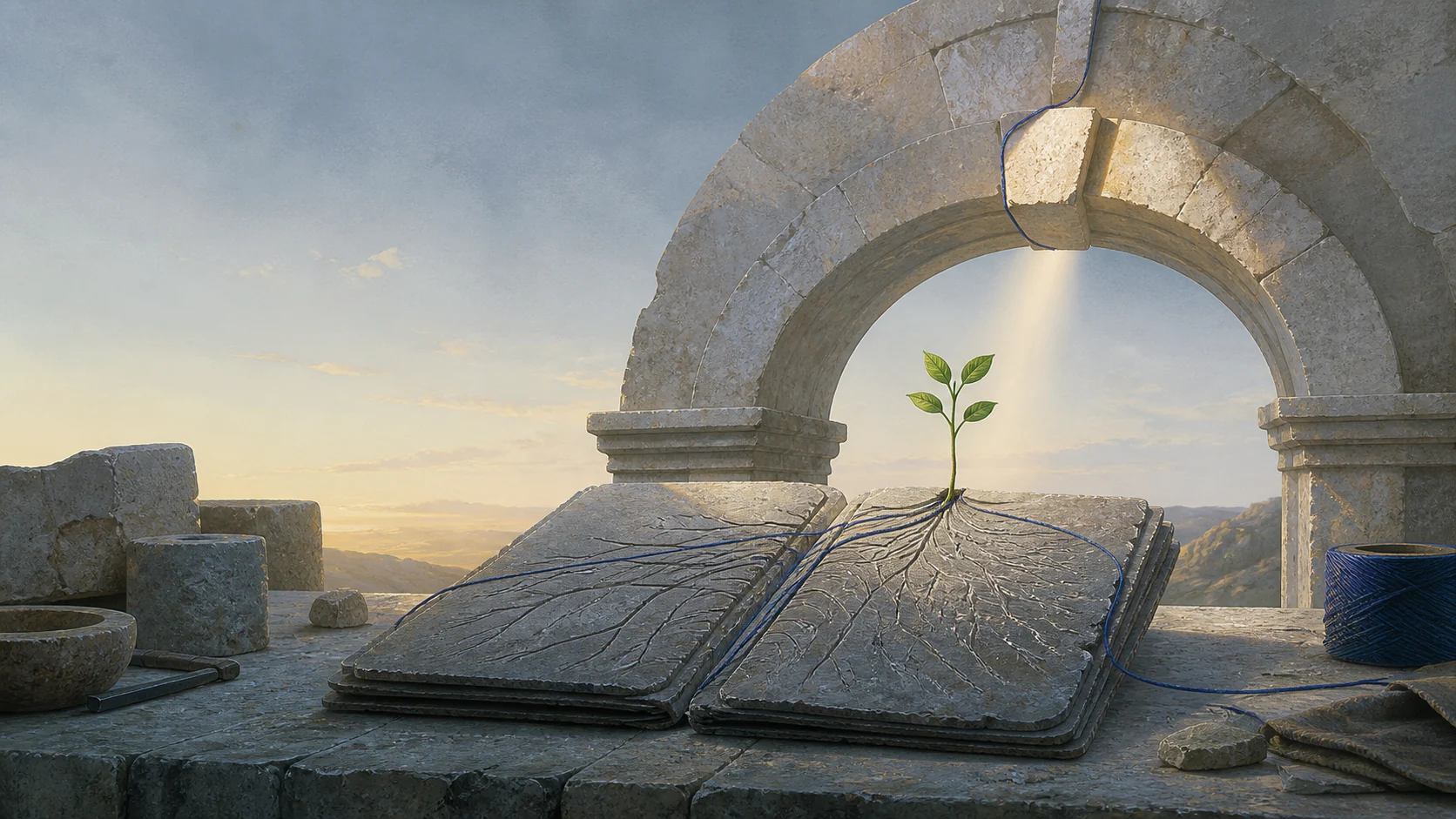
The ledger was not a book of paper, but a library of thin, grey slate tablets, each one etched with the fine, precise script of her forebears. It was the city’s memory, rendered in stone.
One morning, a runner arrived, his face clouded with worry. “The blight has come to the Lower Terrace,” he panted. “The tomato vines wither. The fruit rots before it ripens. The common strain has failed us.”
Lin’s face grew serious. Her first move was not to her climate-controlled seed vault, a cool, dark chamber filled with hundreds of clay jars. Instead, she turned to the stone ledger. With gentle reverence, she pulled a series of tablets from the shelves. She was not looking for a list of seeds she possessed; she was looking for a story.
Her finger, stained with soil, traced the etched lines. This was not a simple inventory. It was a history of transactions. The script told of exchanges, of lineage, of connections. “Sun-Ripened Strain from the Hillside Orchard, traded for three hives of my rooftop bees, year of the late frost.”
She traced the lineage of the failing common strain back through the generations recorded on the stone. She saw where it had been crossed with another variety to increase its sweetness, and where it had been traded for its vibrant color. But as she went further back, following the unaltering memory of the stone, she found a critical entry, etched in her great-grandmother’s elegant hand.
“Original Mountain Strain, traded for its vigor, crossed with the hardy plants from the Harbor Gardens, which thrive in the salt-laced wind.”
The Harbor Strain. The ledger noted that it produced smaller, tarter fruit, but that it was impervious to the coastal blights. The key was not just in knowing what seeds she had, but in knowing their history—their strengths, their weaknesses, their story. The permanent, historical record on the stone tablets provided the context she needed to solve the crisis of the present.
She went to the vault, to a dusty corner where the less popular, less sweet, but more resilient strains were kept. She found the jar marked with a small anchor, the symbol for the Harbor Strain.
As she measured out the tiny, precious seeds into a leather pouch for the runner, she paused. She looked at the rows of jars in her vault—her hoard, her assets, her collection of owned things. It was a great treasure. But then her gaze drifted to the window, to the sprawling city with its thousand unseen gardens on rooftops and in courtyards, all connected by the silent threads of the Mycelial Post, the flight paths of the Pollen Market, and the shared trust in the Guilds’ marks.
The vault was not the wealth, she realized. Nor was the stone ledger itself the wealth. They were tools. They were the secure, unchanging foundation.
The true wealth was the living, breathing, ever-changing web of gardens and gardeners. It was the city’s distributed, biological resilience. And it could only exist, could only thrive and adapt, because it was built upon a foundation of shared, verifiable, and permanent history. The stone made the garden possible.
Lin took a fresh, blank slate tablet from a stack. With a sharp stylus, she made a new entry in the ledger, her own contribution to the continuing story.
“Ancestral Harbor Strain, gifted to the Lower Terrace Gardeners, to be sown against the blight. Year of the Wilting Vine.”
The ledger grew by one small transaction. The story, written on a foundation as solid as the earth, flowed onward. The city, and its life, would endure.